A support network in recovery is the group of people and resources you can turn to for encouragement, accountability, and practical help. Building one means identifying who already supports you, adding new connections through peers and community groups, and setting up regular contact. It grows one honest conversation at a time.
Why a network matters more than willpower
Recovery is often framed as a test of personal resolve, but that framing misses how recovery actually works day to day. Difficult moments — stress, conflict, grief, boredom, celebration — arrive whether or not you feel prepared, and in those moments, having someone to call changes the equation. A support network does not replace your own effort; it gives your effort somewhere to go when it is not enough on its own.
There is also a practical dimension. People in your network notice changes you might miss, offer perspective when your thinking narrows, and provide the simple human contact that makes hard days bearable. Isolation, by contrast, removes all of that at once. This is why nearly every approach to sustained recovery treats connection as infrastructure, not decoration.
Building a network is a skill, not a personality trait. Introverts build strong networks. People who have burned bridges build new ones. The process below is deliberately step-by-step so it works regardless of where you are starting from.
The types of support: know what you are building
A strong network usually includes several different kinds of support, because no single relationship can provide everything. Think of these as roles rather than specific people — one person can fill more than one role, and some roles may be filled by groups rather than individuals.
Peer support. People who understand recovery from the inside because they are living it themselves. Peers offer something professionals and family cannot: the credibility of shared experience. Peer connections often form in group settings, community meetings, or recovery-oriented social activities. The value here is mutual — supporting others strengthens your own recovery too.
Family and close relationships. Partners, parents, siblings, or chosen family who are invested in your wellbeing. These relationships often need repair and renegotiation during recovery, which takes time and honest communication. Not every family relationship is healthy, and "family support" never means tolerating harm — it means the family connections that genuinely support your recovery.
Community groups. Recovery-oriented groups, faith communities, hobby groups, volunteer organizations, or any regular gathering where you are known and expected. Community groups provide routine contact and belonging, which are quietly powerful. The specific type matters less than the regularity: showing up somewhere, consistently, where people notice when you are absent.
Professional support. Counselors, therapists, or other qualified professionals who provide structured guidance. Professional support differs from peer and family support in that it is trained, boundaried, and focused on your goals. If you are deciding between formats, Group Therapy vs. Individual Therapy in Rehab compares two common professional settings.
Everyday allies. Friends, coworkers, neighbors, or mentors who may not be involved in recovery directly but who support the life you are building — the friend you exercise with, the coworker who respects your boundaries at work events, the neighbor you chat with. These relationships normalize your new routines and connect recovery to ordinary life.
You do not need all five categories filled on day one. The goal is a mix that grows over time, with no single point of failure — so that if one relationship falters, the network still holds.
Step 1: Take inventory of what exists
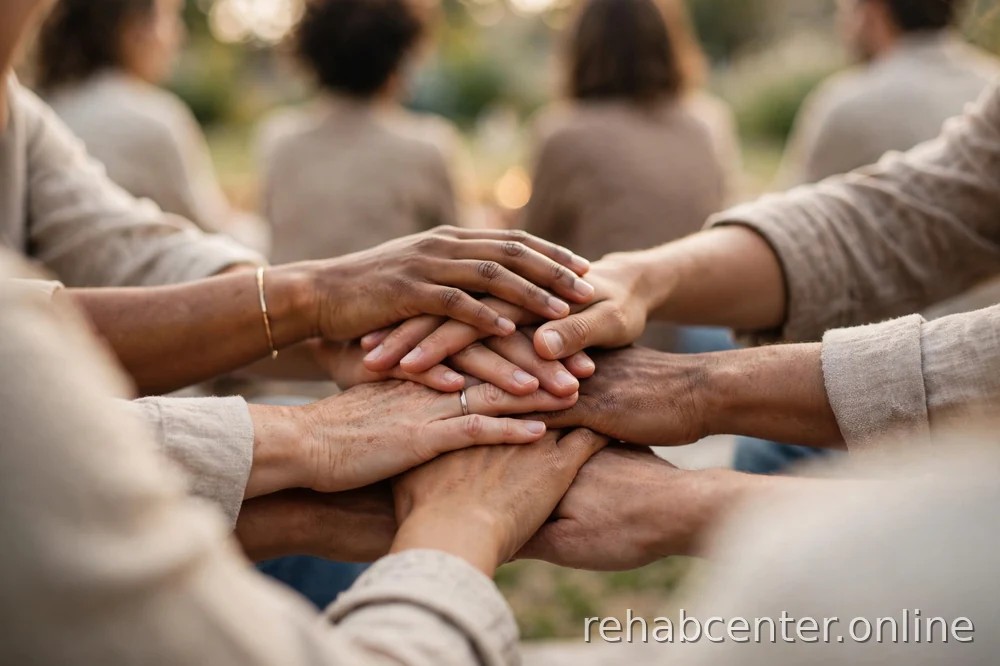
Before adding new connections, look at what you already have. Make an honest list of the people currently in your life, and for each one, note roughly where they stand: actively supportive of your recovery, neutral but kind, unaware, or actively undermining. This is not about judging people — it is about knowing where you stand so you can invest your energy wisely.
Most people discover a mix. There may be one or two people who are already firmly in your corner; those are your starting foundation. There may be relationships that need a conversation about boundaries. And there may be connections tied to past substance use that need distance, at least for now. Being honest about that last category is difficult but important — a network cannot do its job if it includes people actively working against your recovery.
This inventory is private. You do not need to announce it or explain it to anyone. It is simply a clear-eyed map of your starting point.
Step 2: Strengthen one or two existing connections
The fastest way to start building is to deepen what already exists. Choose one or two people from your inventory who are supportive, and have a direct conversation: tell them you are building a support network, explain what would actually help (a weekly call, an invitation to ordinary activities, permission to call when things are hard), and ask whether they are willing to be part of it.
Specificity matters enormously here. "Support me" is too vague for anyone to act on. "Could we talk on Sundays, and would it be okay if I text you when I am having a rough evening?" gives the other person something concrete to say yes to. Most people want to help but do not know how — your job is to make it easy for them.
If family relationships are part of this step, patience helps. Family members may carry their own hurt, fear, or mistrust from the past, and rebuilding takes repeated, consistent behavior rather than a single conversation. Our guide How to Support a Loved One Starting Rehab is written for the family side of this dynamic and may help you understand what they are experiencing.
Step 3: Add new connections deliberately

Existing relationships are the foundation, but most people in recovery need to add new ones — particularly peer connections with people who understand the experience firsthand. This is the step people resist most, and it is also the step that tends to matter most.
Practical ways to add connections include attending recovery-oriented group meetings in your area, joining structured aftercare or alumni activities if your program offers them, volunteering for causes you care about, taking up group activities built around your interests (sports leagues, classes, hobby groups), and participating in faith or spiritual communities if those are meaningful to you. The setting matters less than the repetition: connection forms through repeated, low-pressure contact over time.
A few principles make this step work. Show up regularly, even when you do not feel like it — consistency is what turns acquaintances into connections. Be honest about who you are without oversharing on day one; trust builds gradually. Say yes to small invitations, especially early on. And remember that awkwardness is normal — everyone in a new group felt like an outsider at first.
You do not need to commit to any particular organization or philosophy to benefit from peer connection. Explore options, notice where you feel comfortable and respected, and invest where the fit is genuine. No specific group or program is endorsed here; the principle is the regular, honest contact itself.
Step 4: Build contact into your routine
A network that exists only in theory does not help in practice. The connections you have built need regular contact to stay alive — and regular contact needs to be scheduled, not left to chance.
Simple structures work best: a weekly call with a family member, a regular meeting or group you attend, a standing walk or coffee with a friend, a daily check-in text with a peer. Put these on your calendar the way you would put work commitments. When life gets busy or difficult — precisely when support matters most — scheduled contact keeps the network functioning even when motivation dips.
Technology can help: recurring calendar reminders, group chats for quick check-ins, video calls when distance is a factor. But technology is a supplement, not a substitute. In-person contact, where possible, builds the kind of trust that carries weight in hard moments.
This routine-building connects directly to prevention thinking: Relapse Prevention: Foundational Concepts describes how scheduled structure and a contact list form the backbone of a written prevention plan.
Step 5: Maintain, prune, and repair
Networks are living things. Review yours periodically — every few months, or whenever life changes significantly — and ask honest questions. Which relationships are genuinely supportive? Which have gone quiet and need rekindling? Are there connections that consistently drain you or undermine your recovery?
Pruning is not cruelty; it is stewardship. Distancing yourself from a relationship that actively works against your recovery is a protective act, not a hostile one. You can do it kindly and quietly — less contact, fewer invitations, clearer boundaries — without dramatic confrontations. Similarly, repairing a damaged but valuable relationship is worth the effort when the other person is willing: acknowledge the past honestly, describe what you need now, and let consistent behavior rebuild trust over time.
Also notice the direction of support. Healthy networks are mutual. As your recovery stabilizes, look for ways to give back — listening to a peer, helping a newcomer, showing up for others the way people showed up for you. Giving support deepens your own roots in the network and is one of the most reliable signs of growing stability.
Common obstacles, honestly addressed
"I do not know anyone." Start with structured settings where meeting people is the point — group meetings, classes, volunteer work. One connection leads to others.
"I burned every bridge." Some bridges can be rebuilt with time and consistent behavior; others cannot. Grieve the ones that cannot, repair the ones that can, and build new ones in the meantime. Your past does not disqualify you from connection now.
"I am not a group person." One-on-one connections count fully. A single trusted friend, a counselor, a mentor — depth matters more than format.
"People will judge me." Some might. Many will not, especially in recovery-oriented settings where your story is unremarkable rather than shocking. Choose settings where honesty is normal.
"I do not want to be a burden." Asking for support is not burdening people who have agreed to give it — that is what the agreement is for. And mutual support means you will give back too.
Frequently Asked Questions
How many people should be in my support network?
There is no correct number. What matters is coverage across different kinds of support and enough depth that you have someone to turn to in a hard moment. For some people that is three close connections; for others it is a wider circle. Focus on reliability and honesty rather than counting heads, and let the network grow naturally over time.
What if my family is not supportive of my recovery?
You can build a strong network without family support. Lean into peer connections, community groups, professional support, and chosen family — the people who choose to stand with you regardless of biology. Family dynamics sometimes improve with time and consistent behavior, but your recovery cannot wait for that. Build with whoever is genuinely supportive now. Support earned through shared experience is no less real than family support.
How do I handle friends who still use substances?
Honesty with yourself comes first: if a relationship consistently pulls you toward substance use, distance is protective, not disloyal. You do not necessarily need a dramatic confrontation — reduced contact and clear boundaries are often enough. Discuss the specifics with a counselor or trusted person, since these situations are emotionally complicated and benefit from outside perspective. Protecting your recovery this way is responsible, not disloyal.
Is online support as good as in-person support?
Online communities and video meetings can be genuinely valuable, especially for people in remote areas or with difficult schedules. They work best as part of a mix that includes some in-person contact where possible. The key factors are regularity and honesty, which can exist in either format. Use what is accessible to you and add in-person contact when circumstances allow.
When should I start building my network?
Now — wherever "now" is for you. If you are in treatment, start with peers and counselors there. If you are newly out, prioritize it in your first weeks. If you are further along, it is never too late to strengthen or expand. Networks compound over time: the connections you build this month make next month's building easier. Every connection you add now strengthens the network you will rely on later.
This site is educational information only — not medical advice. If you or someone you know is in crisis, contact local emergency services or a national crisis helpline. Consult a qualified professional about your own situation.